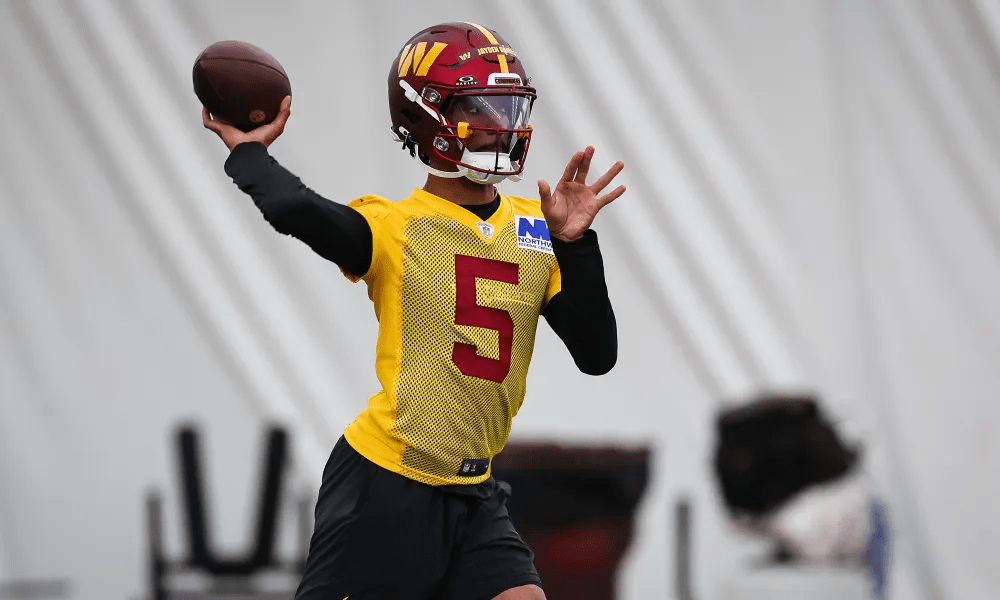
Entering the 2023-2024 NFL season, I had zero expectations for the Houston Texans. Demeco Ryans was a rookie head coach, the Texans 4th head coach since 2020. They had just finished the previous season with a 3-13-1 record, despite playing in the AFC South, a division that has a reputation of being a Mickey Mouse division. They had just drafted Rookie QB C.J. Stroud and pass rusher Will Anderson, so they did have a new core to build around, but being that they were rookies I figured that it would take them a season or two before they actually had a profound impact on winning. Well, I was wrong. Waaaaay wrong. Will Anderson made an immediate impact, winning defensive rookie of the year, recording 7 sacks and 45 tackles as a rookie. While that was super impressive, it wasn’t the main reason the Texans were able to go 10-7, winning their division and their wild card matchup. No, the main reason for that was the emergence of C.J. Stroud as an elite QB in his first year in the league.
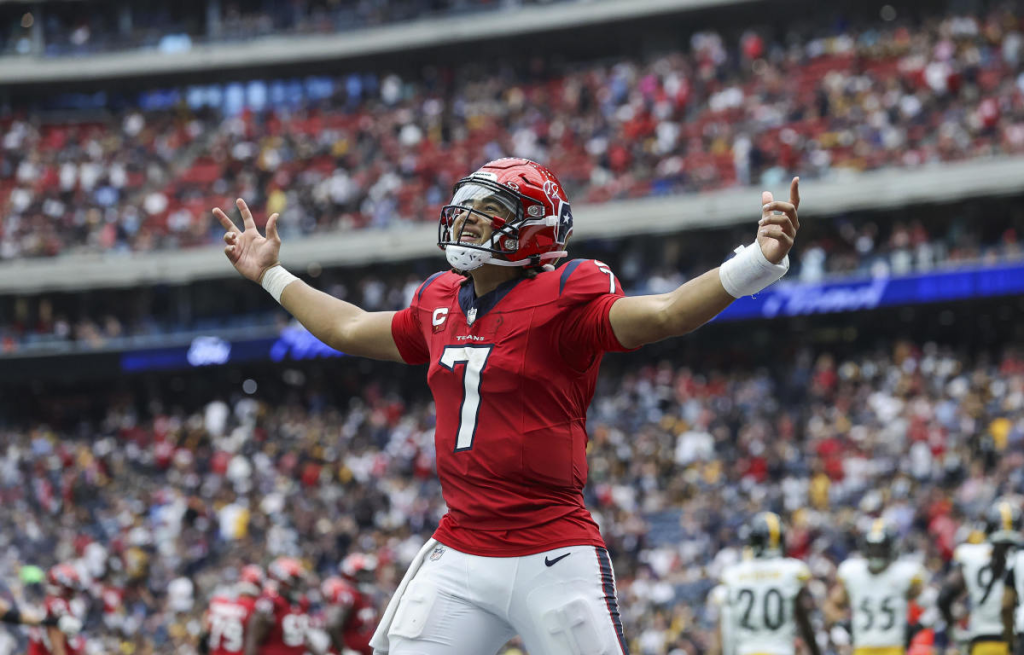
Like Anderson, Stroud won rookie of the year on the offensive side of the ball. In 15 games, Stroud put up 23 touchdowns to just 5 interceptions, throwing for 4,108 yards with a 64% completion percentage on 8.2 YPA. He also did this with an offensive line that was in the bottom half of the league, getting sacked 2.5 times per game and dealing with constant pressure. In other words, Stroud was fucking incredible, playing like a 10 year vet despite being a rookie. He had amazing poise in the pocket, seemed to process NFL defense at an incredibly high level, and featured enough mobility to extend plays by scrambling outside of the pocket while still being accurate enough to deliver excellent throws on the run. He then won his first playoff game, posting a statline of 16 completions on 21 attempts for 274 yards and 3 touchdowns with no turnovers. He finished the game with a passer rate of 157.2, keep in mind 158.3 is considered a perfect passer rating. To me, it was the best rookie QB season I had ever seen, beating out Brock Purdy from the year prior, who beat out Justin Herbert from 2020, who beat out Dak Prescott in 2016, who beat out the trio of Luck, RG3, and Russell Wilson in 2012, who beat out Cam Newton in 2011. Before Cam, I would have taken arguments for 04 Ben Roethlisberger, 83 Dan Marino, or possibly Mark Sanchez or Joe Flacco from 09 and 08 respectively. That had me thinking: Almost all of the QBs that I just listed were from 2010 or later, with all but 1 being from post Y2k. At first, I thought that was just because I’m 25, or as my older coworkers like to say, a baby. However, when I went and did a deep dive, I found that I was pretty much spot on with my analysis. The best rookie QB seasons have all been very recent, and overall they have gotten better and better. But what Stround did, well, surely we wouldn’t see a rookie QB season like that for a long time. He created explosives, limited turnovers, and won a playoff game, when will we see something like that again? How about the very next year?

Commanders at Buccaneers, tied game, 2 minutes left. The Commanders have the ball at the Buccaneers 45-yard line on 2nd and 10, needing 10-15 more yards to get into field goal range and win the game. Commanders quarterback Jayden Daniels was having an excellent game on the road in his first career playoff start, something that has only happened a few times in NFL history. The Commanders are lined up out of the shotgun in 11 personnel, meaning there was 1 running back, 1 tight end, and 3 wide receivers.
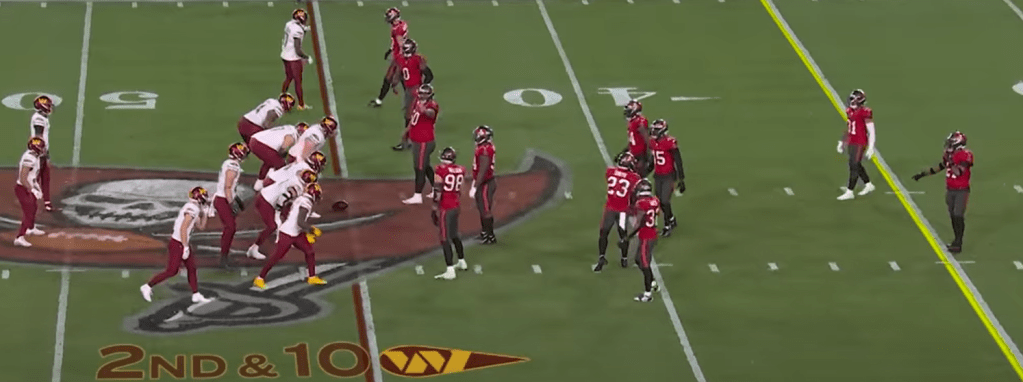
They motion wide receiver Luke McCaffrey from the right side to the left, which forces the man the arrow is pointed out, Buccaneers cornerback Josh Hayes, to signal to the safety on the left side of the field to switch matchups. When Josh Hayes does this, Daniels knows that he is facing man coverage, and that Hayes asked for a switch. This is where Daniels knows he is going to win this play.
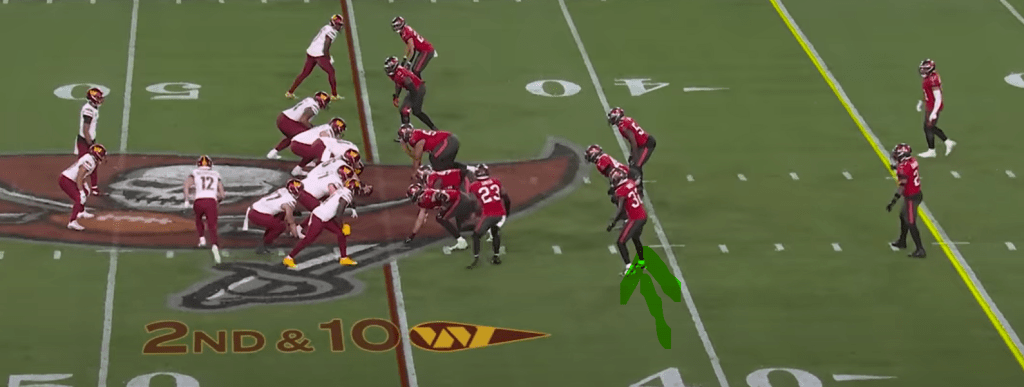
He hikes the ball as McCaffrey gets to the other side, knowing that he is facing 1 on 1 man coverage across the board, which means there will be a blitz. He knows the safety isn’t dropping back into zone, as he just had to switch onto the receiver in motion. The Buccaneers rush 6, going all out to try to create a negative play for the Commanders and hopefully force a turnover.
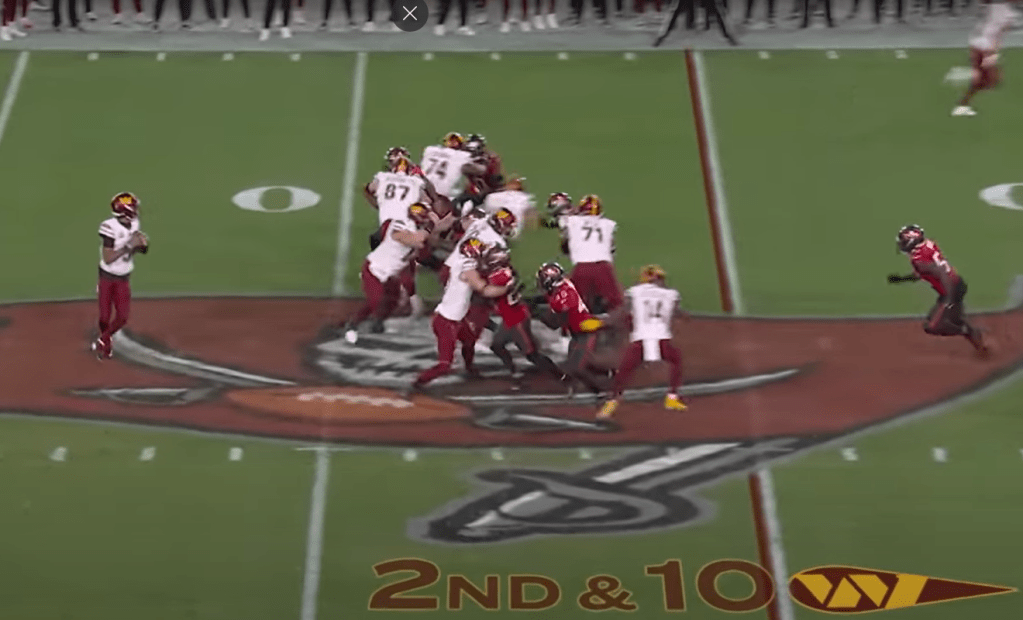
With most rookie QBs, this would be a very tough thing to process in real time, given the weight of the moment. If you fuck up here, best case you are looking at 3rd and 10 or overtime, but worst case you turnover the ball or face 3rd and long, where you will inevitably have to punt the ball back to the Buccaneers. Good thing Jayden Daniels isn’t most rookie QBs. He stays calm, fakes the handoff to running back Austin Ekeler, then quickly gets the ball out to him in the flat on the left side of the field, which is now wide open do the motioning McCaffrey running up the field, along with wide receiver Terry McLaurin, who was already on the left side. If he can get this ball out, all Ekeler will need to do is make 1 man miss and he will make a big play. The only problem is that the defender, Buccaneers linebacker Yaya Diaby, is anticipating this pass.
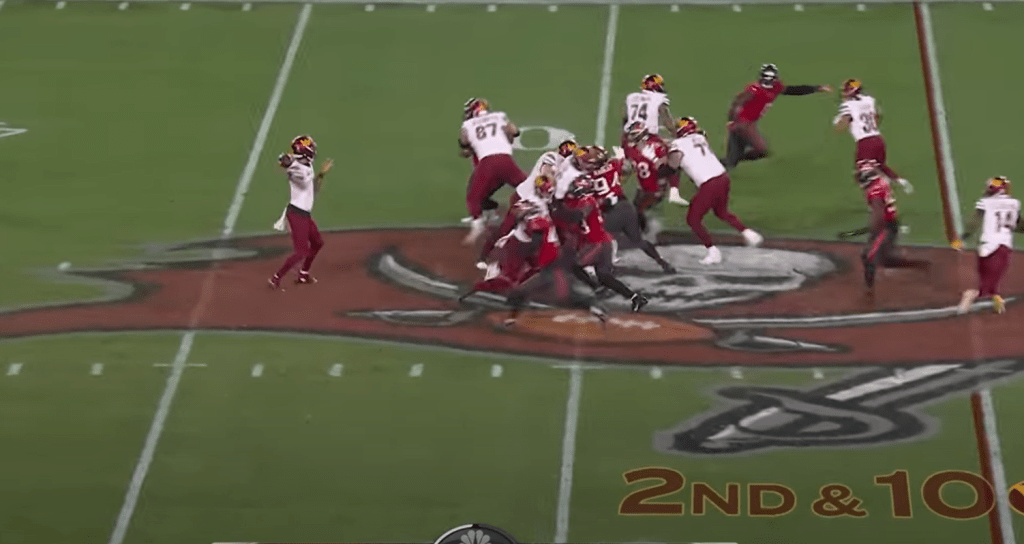
So, he needs to get Ekeler the ball in a spot that only he can catch it. The biggest priority is making sure there is no chance at a turnover. Daniels delivers a perfect bell where only Ekeler can catch it, he beats the defender and runs up the field for 18 yards. Ugh, look at that fricken ball placement! Game Over, Commanders win.
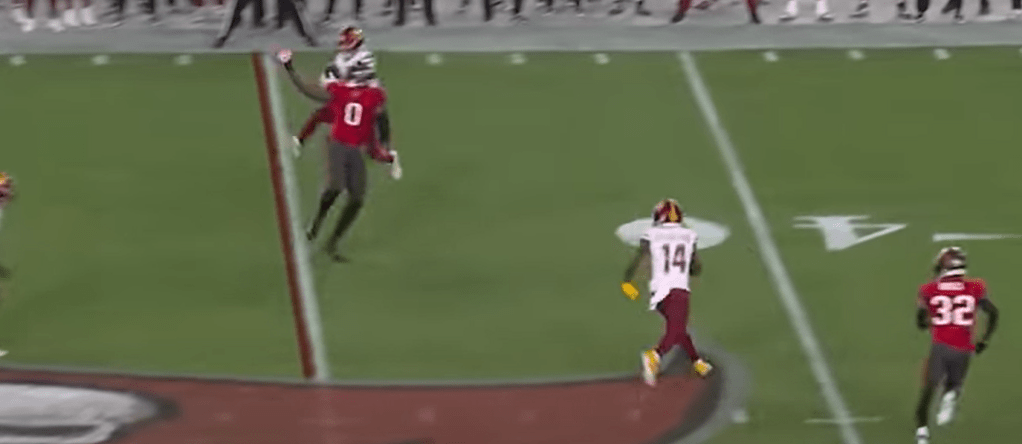
Just like that, the new best rookie QB season ever was just clinched, just 1 year after thinking nobody could possibly have a better rookie season than C.J. Stroud. Here I was, in pure awe and shock that the Commanders upset the Buccaneers, when I had the same thought: we won’t see a rookie QB season this good for a while. Except actually, we will probably see it very soon. I wanted to take a deeper look into rookie quarterback play to try to find out why we were seeing such excellent play right out the gate for these guys, where previous generations of quarterbacks often took 2-3 years before they turned into quality starters. Here is what I found
The College and NFL Game Are More Similar Than Ever.
Now when I say this, I do acknowledge that there will always be some variance between the college and pro game. The hash marks being wider in college will affect the amount of space you get on either side of the field, and the difference between playing 18-22 year olds versus playing grown ass men in the NFL will always be relevant as well. So what are the similarities? Let’s start with personnel. In both college and NFL, most plays are run out of 11 personnel, with both leagues using it at more than a 30% higher rate compared to the next personnel grouping. College has a little more personnel diversity (utter woke nonsense!) than the NFL does when choosing non 11 personnel, but both use 11 anywhere from 55-60% of the time on average per Mike Bursik at Statsbomb.com, I will link his article below. Just because I might have family or people that don’t know my humor as much reading this, I must clarify I am joking when I say utter woke nonsense. If anybody takes my sarcasm seriously going forward, that’s on you, now back to the subject at hand. Outside of 11 personnel, colleges tend to spread out the field more than the NFL, likely due to the wider hash marks creating more space for receivers to operate on the longer side of the field. This means they run more plays with no tight ends or running backs more often than the NFL. While this is a major difference, it is one that makes it so the quarterback has to throw the ball more often since there is literally no running back on the field for these formations. Conversely, the NFL runs more jumbo formations than college, using multiple tight ends or running backs at a much higher rate. The main point I want you to take away is that when it comes to personnel groupings, the NFL and college run the most basic personnel at essentially the same rate, meaning there isn’t some huge adjustment in the types of players on the field on any given snap.
I would also like you to take a look at how much NFL teams work in the shotgun compared to the past. If you go back to pre-Y2K NFL football, the shotgun was used around 30% of the time, while under center snaps made up for around 70% of snaps. The 2000s saw the college game slowly start using more shotgun formation, eventually getting to the point in the 2010s where the college game had the ratio flipped, running roughly 70% of plays out of the shotgun and only 30% of plays from under center. Why did this switch occur at the college game first? As I mentioned earlier, college teams were running the spread offense at a higher rate than the NFL. Again, spread is where there are 5 wide receivers on the field, with no running backs or tight ends. Because of this, teams had to operate out of the shotgun. This gave their quarterback extra time to avoid pass rushers, as they started further away from them when in this formation. While the NFL was never going to adopt full spread formation at quite the rate of college due to how talented the pass rushers were, you did see NFL teams increase their amount of 4 wide receiver personnel, with a running back or tight end being on the field to help pass protect in these scenarios. These still required the quarterback to operate more out of the shotgun, by 2022 NFL teams were running plays out of the shotgun at 66% of snaps, compared to just 37% in 2009 per Paul Domowitch at the 33rd Team, link to his article will be listed below. So we already know that the types of players on the field had become more similar between college and the NFL, but now the exact formation these players were lined up in got closer in similarity as well. So in terms of the way it looked, the NFL game and college were getting harder to blur the lines against, but there are still some things left unanswered. How are rookie quarterbacks recognizing the types of coverage in the NFL? With increased talent level, defensive coordinators are able to disguise their coverages and mix up coverages more often than the college level, so how are college quarterbacks coming into the league being able to process this at the same speed or even faster than they had to in college?
The Increase in Pre-Snap Motion.
The biggest answer to this question has been the increased use of motion in the NFL. Motion is when the offense moves a player behind the line of scrimmage pre-snap. Why would NFL teams do this? With motion, you can recognize coverages easier. Man defenses will have their corner follow the wide receiver that is in motion, or have them call for a switch with a defender on the other side of the field, which could potentially create a mismatch for the offense. If the defense is in zone, you will see that the defense is making no adjustments to the pre-snap motion, so right away the quarterback should already know the type of coverage that the defense will be playing. This takes away, in my estimation, anywhere from 1-2 seconds of post-snap coverage reading that quarterbacks previously would have had to do, which makes life much easier on the QB. For a rookie QB, this is huge! If you already know the coverage pre-snap, it means you should be able to know who is going to get open and when at a higher rate than previously possible. The NFL has seen motion usage increase dramatically over the last 10 years, with the league’s best offensive minds running motion on most of their plays. Ever heard of Andy Reid? How about Sean McVay? Can I interest you in some Kyle Shanahan? What about some Mike McDaniel? These 4 have led some of the best offenses in the 2020s, with pre-snap motion being the biggest part of it. How these plays end up being designed to go post-snap are all different amongst these head coaches, but they all make the quarterback’s job easier by using pre-snap motion to reveal the defensive coverage. Whether they are trying to run the ball more effectively, play west-coast offense and get the ball out quick, or take vertical shots deep down the field, the common denominator in all of these coaches’ offense is the pre-snap motion. Okay, so we now know that the college game is closer to the NFL game than it has ever been, and coaches are scheming offenses in a way to make life even easier on their quarterbacks. Is there something that the college QBs are doing themselves though that has led to them becoming more effective at the NFL level?
This is the Most Athletic Quarterbacks Have Ever Been.
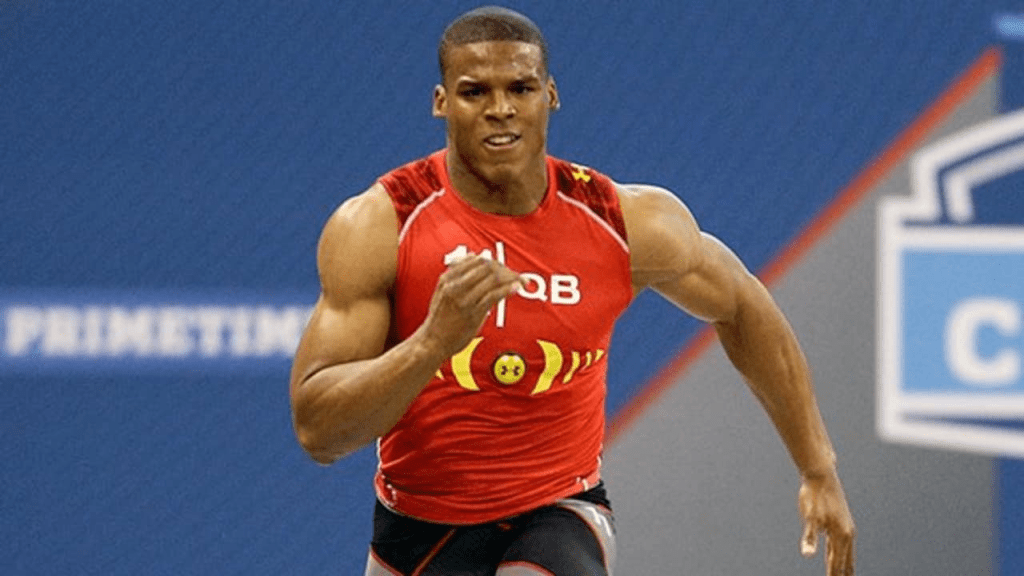
This is the most obvious part, which is why I wanted to leave it for the end. Quarterbacks are doing insane things that outside of Michael Vick, John Elway, Randall Cunningham and Steve Young, didn’t used to happen. I’ll use my favorite team as an example. Phillip Rivers is more than likely going to end up as a hall of fame quarterback. That being said, he was an absolute statue in the pocket, and when he did run on the rare occasion, looked like a giraffe that was also injured. Now look at our current quarterback, Justin Herbert. Yes, I know it isn’t the best time to talk about him, but stay with me. He is able to make every throw that Phillip Rivers was able to make. However, in addition to that, he is able to escape the pocket and either throw on the run, or scramble for a big game. You can do this same thought experiment across multiple franchises. The Ravens, going from Joe Flacco to Lamar Jackson. The Seahawks, who went from Matt Hasselbeck to Russell Wilson. The Colts, who went from Peyton Manning to Andrew Luck. Not to mention all the other teams who didn’t have great QBs but then drafted athletic freaks at the position, like the Panthers with Cam Newton and the Commanders with Jayden Daniels. To put it into perspective, Phillip Rivers’ 40-yard dash time was 5.08 seconds. Justin Herbert’s? 4.68. That’s almost a full half second faster than Rivers, who also became much slower as his career went on. This is not a knock on Rivers at all, I just mentioned how he was a hall of fame quarterback. But it goes to show just how much more athletic quarterbacks are today compared to the past. Okay, so what the quarterbacks are more athletic, what does that mean? A couple things: 1. With more athletic quarterbacks, you can run the read option and run pass option plays, as the quarterback is now a threat to keep the ball and run. This allows for the running back to have at least 1 less defender focused on him when running out of the shotgun, which is huge. And if you have an all-time athlete like Lamar Jackson, you get results like the play below, where multiple players account for stopping Lamar despite the fact that the Ravens had Derrick Henry, the best running back the NFL has seen since Adrian Peterson, set to receiver the hand off. With all the focus on Lamar, Henry was able to easily outrun the Steelers defense for a massive touchdown.

This play just straight up could not have happened if Joe Flacco was the Ravens quarterback. In addition to the read option, the run pass option allows the quarterback to hand off if the defense is playing the pass, but if they are playing either the handoff or the quarterback keep, it allows the QB to fake the handoff and pass to wide receivers on slants, bubbles, or curl routes, which leads to solid gains, or possibly even explosive plays. The 2nd benefit to the athletic QB is that because they are running better due to teams assigning defenders to the quarterback, it now sets up easier 2nd and 3rd downs for the offense, which allows you to take more deep shots if you want or make getting the first down easy by calling short, quick pass plays. All of this makes life easier on the quarterback, which in return makes life easier on the offense.

So the quarterbacks entering the league are more athletic than ever, they are playing in college offenses that are closer and closer to NFL offenses, and NFL coaches have utilized motion to make it easier for quarterbacks to identify coverage pre-snap and create mismatches. What does this mean for the league going forward? For starters, I think the days of a quarterback getting drafted in the first round with a 5 second 40 time are done. You simply need to have some mobility as a quarterback in order to succeed in today’s game, the days of the traditional pocket passer have been over for a few years now. I also think that going forward, safeties and linebackers will start to become indistinguishable from one another, as you’ll either need your linebacker to be able to play pass coverage or will need your safeties to be able to play run defense even more than ever. The middle linebacker position may just disappear entirely if I’m being honest. I also think that we see more defenses like the Vikings, where they just blitz the hell out of the opposing offense whether they are in man or zone coverage. This will lead to more explosives for the offense or more turnovers, which to me means football is going to get even more exciting as the league goes on. Look at how in the past 5 years, we have really started to see teams be more aggressive on 4th down. Before, teams would tend to just kick the field goal and take their 3 points. Now, you either will pick up the 1st down and keep the drive alive, or you will get stopped and give the other team the ball. Whether you agree with this philosophy or not, you have to admit that it has led to games being even more entertaining. This same logic is why I think defenses will blitz more, as teams will begin to gamble more on the boom or bust potential of sending pressure at these mobile QBs. Right now, If you just sit back and rush 4 throughout the game, unless you have a God tier defensive line, you are going to make life super easy on the new generation of quarterbacks. These guys are too smart and too athletic now, as we have seen through the past 15 years, and as recent as last night with Jayden Daniels. You have to send heat at these guys, and they may end up really cooking you with some big plans, but they also may turnover the ball and get sacked, creating easier scoring opportunities for the offense. Essentially, if it is damn near impossible to stop these guys, you might as well use your defense like an offense and try to generate explosive plays of your own. In conclusion, while this Jayden Daniels season has been the most impressive rookie QB season I have ever seen, I am almost certain I will see a more impressive one within the next 5 years.
Citations
Bursik, M. (2024, October 2). Personnel Usage & Diversity: NFL vs. College Football. Hudl Statsbomb | Data Champions. https://statsbomb.com/articles/football/personnel-usage-diversity-nfl-vs-college-football/
Domowitch, P. (2023, November 14). NFL teams moving out from under center, riding shotgun. The 33rd Team. https://www.the33rdteam.com/nfl-teams-moving-out-from-under-cenet-riding-shotgunnfl-teams-riding-shotgun/
 Coast2CoastSports
Leave a comment